
This post may contain affiliate links, and I earn from qualifying purchases. Please read our privacy policy.
There are a lot of lemon desserts out there—lemon cupcakes, no bake lemon pie, lemon loaf—but few are as quietly perfect as Lemon Custard Pie.
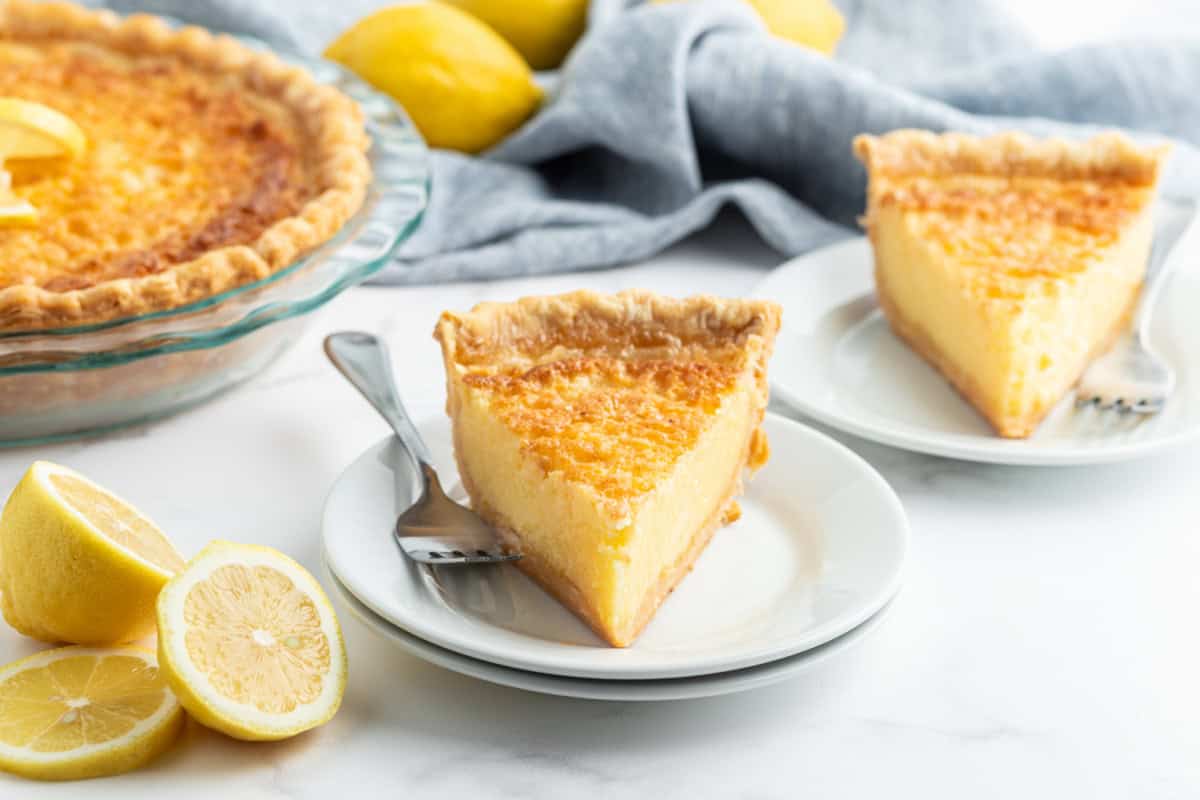
This pie is simple in the best way. A buttery crust holds a smooth, sweet-tart lemon filling that bakes into a custard with a slightly golden top and a silky center. It’s rich without being heavy, bright without being overly tart, and somehow feels both old-fashioned and completely irresistible at the same time.
In the South, this dessert is often called Lemon Chess Pie, a classic pie known for its custard-like filling made with eggs, sugar, butter, and a small amount of cornmeal. The cornmeal gives the pie a subtle texture that sets it apart from other custard pies.
If you love lemon desserts, this one deserves a spot in your baking rotation.

Why Is It Called Chess Pie?
No one knows exactly where the name “chess pie” comes from, but there are a few popular theories.
One idea is that the pie was traditionally stored in a “pie chest,” which eventually shortened to “chess pie.” Another theory suggests that when people asked what kind of pie it was, the answer was simply “just pie,” which over time sounded like “chess pie.”
Regardless of the origin, chess pie has become a beloved Southern dessert known for its rich custard filling made from simple ingredients like eggs, sugar, butter, and cornmeal. Try our recipe for Chocolate Chess Pie too. And if you’re a fan of Southern desserts, you should try our Easy Layered Banana Pudding.

Why There’s Cornmeal in the Filling
Cornmeal is one of the signature ingredients in traditional chess pie.
It doesn’t make the pie gritty or grainy—instead, it helps stabilize the custard and adds just a hint of texture. That subtle difference is part of what gives chess pie its distinctive character.
In this lemon version, the cornmeal also helps balance the bright citrus flavor.

How Lemon Custard Pie Comes Together
This recipe is refreshingly simple.
- Start by placing the pie crust into a 9-inch pie plate and freezing it briefly so it holds its shape during baking.
- While the crust chills, whisk together the eggs, milk, sugar, cornmeal, lemon juice, lemon zest, and salt. Melted butter is added last to create a rich custard base.
- The mixture rests for a few minutes so the cornmeal can soften before baking.
- After a quick blind bake of the crust, the lemon filling is poured in and the pie bakes until lightly golden with a gently jiggling center.
- As it cools, the custard sets into a smooth, sliceable pie.

How to Tell When Lemon Custard Pie Is Done
The key to perfect lemon custard pie is baking it just long enough for the filling to set without becoming overcooked.
Here’s what to look for:
- The edges should look set and lightly golden
- The center should slightly jiggle when the pie plate is gently shaken
- The top may develop a lightly caramelized surface
As the pie cools, the custard will continue to firm up.

Recipe Tips
- Use freshly squeezed lemon juice (over bottled) for the brightest flavor, and use freshly grated lemon zest, which contains the lemon’s natural oils, which add extra flavor.
- Use a glass or metal pie plate for the most even baking.
- Let the filling sit briefly before baking so the cornmeal softens- resulting in a smoother custard.
- Watch the crust while baking- if it browns too quickly, loosely cover the edges with foil.
- The center should slightly jiggle when the pie is finished baking.
- Let the pie cool completely before slicing so the custard sets properly.
Lemon Custard Pie vs Lemon Meringue Pie
While both pies feature lemon filling, they’re actually quite different.
Lemon custard pie (lemon chess pie):
- baked custard filling
- rich and silky texture
- no meringue topping
- slightly caramelized surface
- cooked lemon curd filling
- topped with fluffy meringue
- lighter and more tart
If you prefer lemon desserts that are rich and creamy, lemon custard pie is the winner.

Storing Lemon Custard Pie
Once cooled, cover the pie and store it in the refrigerator for up to 4 days.
Serve chilled or let slices sit at room temperature for about 15 minutes before serving.

Lemon Custard Pie

Ingredients
PIE CRUST:
- One refrigerated pie crust (or your favorite pie crust recipe)
PIE FILLING:
- 5 large eggs
- ¼ cup whole milk or cream
- 1¾ cup granulated white sugar
- 2 tablespoons regular (not whole grain) cornmeal
- 4 tablespoons freshly squeezed lemon juice
- 1 tablespoon finely grated lemon zest
- ¼ teaspoon salt
- ½ cup (1 stick) salted butter, melted
Instructions
- Preheat the oven to 450℉.
- Place the pie crust into a 9-inch pie plate. Press it firmly onto the bottom of the pan and up the sides. Do not stretch the crust. Cut the excess off the overhang and tuck the rest under to form a decorative edge around the pie. Prick the bottom of the pie crust with a fork and place it into the freezer for 20 minutes.
- In a large bowl, whisk together the eggs, milk, sugar, cornmeal, lemon juice, lemon zest and salt. Whisk until well-combined. Then whisk in the melted butter. Let the mixture sit while the pie crust is baking (to soften up the cornmeal).
- Bake the pie crust (from the freezer to the oven) for 8 minutes and then remove it from the oven. Reduce the oven temperature to 350℉.
- Whisk the lemon filling to combine one more time, and then pour it into the pre-baked pie crust. Bake at 350 for 35 to 40 minutes- or until the pie is lightly browned and the center jiggles a little when the pie is shaken. Watch the crust on the edges to make sure they are not browning too much.
- Cool completely before cutting and serving.
Notes
- Fresh lemon juice gives the pie the best flavor.
- Allow the pie to cool completely so the custard sets properly.
- If the crust edges brown too quickly, cover them loosely with foil.
- The pie will firm up as it cools, so a slight jiggle in the center is normal.
- Store leftover pie covered in the refrigerator for up to 4 days.
- This pie is delicious served chilled or slightly cool.
Nutrition
This recipe comes from RecipeBoy.com